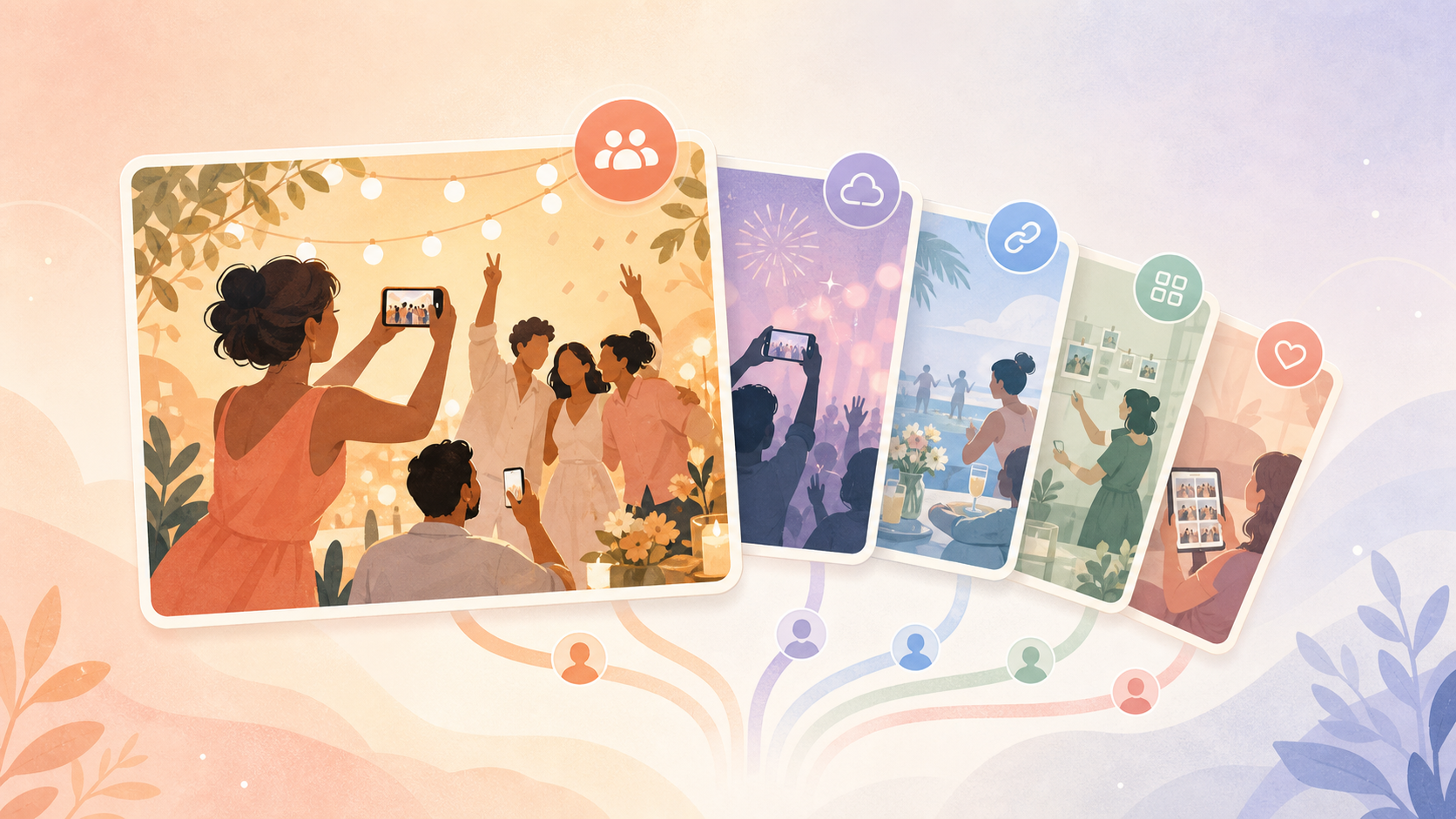
once.film built its following on a simple but delightful premise: give everyone a roll of virtual film, lock the photos until a midnight reveal, and recreate the anticipation of dropping off an analog roll at the drugstore. The film-grain filter and the delayed reveal feel genuinely different from the tap-and-post immediacy of Instagram or Google Photos, and for groups who want a low-pressure, surprise-oriented photo experience, it delivers.
Where the roll mechanic creates friction
The friction starts when the roll mechanic fights the moment. At a wedding cocktail hour, a graduation party, or a family reunion, guests often want to see what others are capturing right now — not 24 hours later. The free tier limits how many exposures you get per roll, and once.film's subscription cost adds up if your group hosts more than a few events per year. Some users also find that asking every guest to install a dedicated app before the event starts is a harder logistical ask than it first appears.
Two camps of once.film users
People searching for once.film alternatives tend to fall into two camps: those who love the surprise-reveal feel and want to keep it — just for a smaller, closer group — and those who chose once.film primarily for collaborative photo capture at events and now want real-time visibility, cross-platform reliability, and more generous storage. The five apps ranked below serve both audiences; each entry notes specifically who it fits best and where it falls short.
How we evaluated and ranked each app
We evaluated apps on five dimensions. Cross-platform support — does the app work equally well on iOS and Android, or does it leave half your group on a second-class experience? Privacy posture — does the platform train AI models on your uploaded photos, and how long does it retain images after deletion? Real-time or near-real-time sharing — can guests see photos during the event, without an artificial delay that turns the app into a novelty rather than a tool? Free-tier generosity — can a group of 10 to 20 people share a full day of photos without hitting a paywall? And collaborative event quality — does the UX orient around a shared occasion, or is it a solo feed with a sharing bolt-on?
Apps that require all participants to be on the same device ecosystem (Apple-only or Android-only) ranked lower even when their camera features are strong. Apps whose primary use case is solo editing or daily social posting ranked lower than apps purpose-built for group events, even when those apps support a sharing feature on the side. Film grain and vintage aesthetics appear as differentiators only where they are the app's core identity — not where they are one filter among hundreds.
sync.camera — real-time collaborative albums, no install required
sync.camera is built from the ground up for the shared-event scenario: a host creates an album, guests join via a QR code or short link, and photos appear in a live feed the moment anyone uploads them. There is no app install required for guests — the web-based camera and gallery work in a mobile browser, while the full iOS and Android apps are available for hosts and power users who want push notifications and offline caching.
The privacy story is a genuine differentiator at this price point. sync.camera does not train AI models on uploaded photos, and events can be configured to auto-delete after a set window. The shared album structure is purpose-built for occasions rather than everyday social feeds, which means photos from your cousin's wedding are not mixed into an algorithmic timeline alongside ads. It also makes the app a practical choice for family gatherings where some attendees are not comfortable with social-media-style sharing.
The honest trade-offs: sync.camera is a newer platform, so its third-party integration catalog — photo book printing, export to Google Drive, and similar — is thinner than what Google Photos or Apple Photos offer after years of development. Guests who are used to apps already installed on their phone may find opening a link one extra step, even though no download is needed. The free tier is suitable for a single small event; groups with frequent, large events will need a paid event pass. And if a film-grain aesthetic is important to your group, sync.camera prioritizes accurate real-time capture over stylized output and does not include a built-in vintage filter.
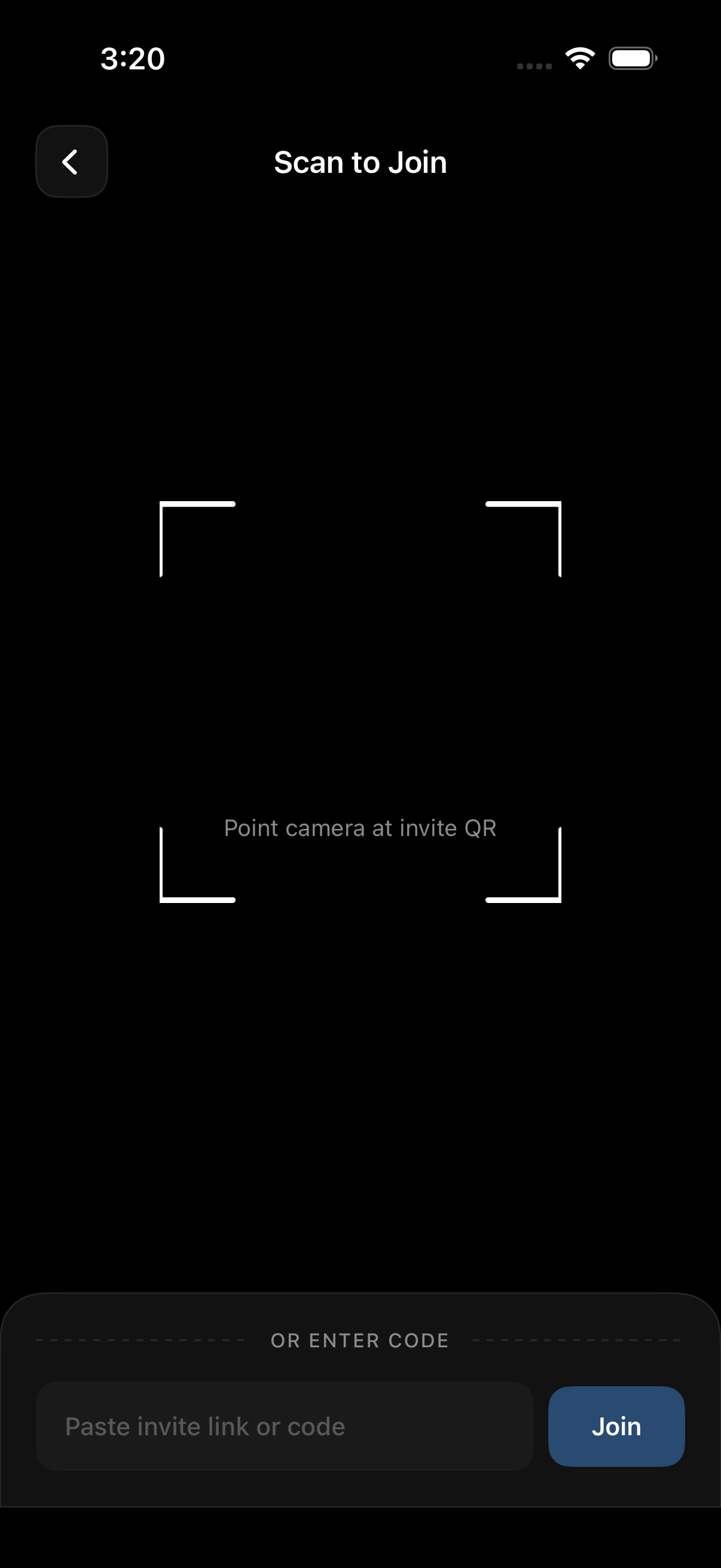
Guests join by scanning the event QR code or entering the invite code, with no account needed.
Pros
- No app install required for guests — anyone joins via a QR code or link in a mobile browser
- Real-time photo feed: all contributors see photos as they are uploaded, with no artificial delay
- Cross-platform across iOS, Android, and web
- Does not train AI models on your uploaded photos
- Album structure is oriented around events rather than a continuous social feed
- Host controls who can contribute and view
Cons
- Newer platform with a thinner third-party integration catalog than Google Photos or Apple Photos
- Guests must open a link rather than use a pre-installed app they already have on their phone
- Free tier is limited to small or single events; larger or frequent events require a paid pass
- No built-in film-grain or vintage aesthetic filter for groups that want that look
Google Photos Shared Albums — generous storage, universal device support
Google Photos is the default photo backup app on most Android phones and a widely used app on iOS, which means there is a good chance many of your guests already have an account. Shared albums let contributors add photos directly from their camera roll without re-shooting, the 15 GB of free Google storage is generous enough for a full day of event photos at standard resolution, and the experience is nearly identical on iOS and Android.
Where Google Photos falls short as a once.film replacement is everything around the experience of sharing. There is no event-oriented UX — a shared album is a flat grid with no cover theme, no reveal mechanic, and no guest-facing camera integrated into the invite flow. Contributors need a Google account to add photos, which can be an obstacle for guests who use Apple ID exclusively. And Google's consumer privacy terms permit using uploaded content to improve products including AI features, which may be a dealbreaker for privacy-conscious groups.
Google Photos is the right pick when your group is large and mixed iOS/Android, cost is the primary constraint, and you do not need a curated event experience — just a shared folder everyone can drop photos into after the fact.
Pros
- 15 GB of free shared storage across Google Photos, Drive, and Gmail
- Works on iOS and Android with near-identical feature sets
- Contributors can add photos from their camera roll without re-shooting
- Google Lens search and object recognition work on shared album content
- Virtually no learning curve for Android users who already back up to Google Photos
Cons
- Google's consumer privacy policy permits using uploaded content to improve AI and other products (Google Workspace accounts have stricter terms)
- Contributors must have a Google account to add photos
- No event-specific UX: shared albums are flat containers with no reveal mechanic or guest camera
- No film grain or vintage aesthetic
- Notifications for new contributions are easy to miss in a busy inbox
iCloud Shared Albums — zero setup for iPhone households
iCloud Shared Albums require zero setup for most iPhone users: the feature is built into the native Photos app, enabled in Settings, and any iOS or macOS user can be invited via iMessage or email. Photos sync within seconds across Apple devices, Live Photos and videos are supported natively, and there is no additional subscription cost beyond what participants already pay for iCloud.
The hard limit is ecosystem lock-in. Android users cannot contribute to or view iCloud Shared Albums — not even via a web link with a modern browser. If any member of your group is on Android, iCloud falls off the list immediately. The album structure is also flat, with no event-theme UI, no reveal mechanic, and no guest camera: contributors add from their existing camera roll after the event rather than capturing in real time through a shared experience.
For all-Apple households — a family with iPhone and Mac on every device, or a friend group where everyone uses iOS — iCloud Shared Albums are the lowest-friction option on this list. For mixed groups, look elsewhere.
Pros
- Built into the native iOS and macOS Photos app — no extra install or account creation needed
- Free, included with any Apple ID at no additional cost
- Instant sync across Apple devices
- Supports Live Photos and videos natively
- Apple's privacy policy does not use Photos library content for advertising
Cons
- Android users cannot contribute or view shared albums — not even via a web link
- No real-time event camera; contributors add from their camera roll after shooting
- No reveal mechanic, event theme, or curated event UX
- No film grain or vintage aesthetic
- Subscriptions to larger iCloud plans may be needed if the album owner has limited storage
Locket Widget — ambient home-screen delivery for small circles
Locket Widget takes the once.film delay-and-reveal premise and extends it into an ambient home-screen experience. Instead of unlocking a shared roll at midnight, photos from close friends appear as live widgets on your lock screen or home screen throughout the day. The dual-camera mode captures front and back simultaneously, giving each photo a candid, in-the-moment quality that once.film users will recognize.
Locket is explicitly designed for small, intimate circles — the app's own onboarding targets couples, best friends, and tight family groups of roughly 2 to 8 people. That intimacy is the feature, not a limitation: ambient widget delivery feels more personal than a shared album browser. Locket is available on iOS and Android, though the iOS version is more mature.
The trade-off is scale. Locket does not have an event-album structure, and inviting 30 wedding guests produces a chaotic widget feed rather than a curated gallery. There is also no browsable archive — photos live in the widget and a recent feed, not a searchable library. If you want the spiritual successor to once.film's surprise aesthetic for a small group of close people, Locket is the closest match on this list. If you need a solution for more than a handful of contributors, a different app will serve you better.
Pros
- Photos appear directly on recipients' home-screen or lock-screen widgets — genuinely ambient
- Dual-camera capture (front and back simultaneously) produces candid, unposed photos
- Closest spiritual successor to once.film's delayed-reveal feeling for small groups
- Available on iOS and Android
Cons
- Not designed for event-scale groups; more than 8 to 10 contributors creates a confusing feed
- All participants must install the Locket app; Android support is newer and more limited than iOS
- No browsable album archive; photos are ephemeral unless manually saved
- No event-specific UX, cover page, or host controls
- Widget delivery means late joiners cannot scroll back through a full event gallery
BeReal — notification-triggered dual-camera for authentic daily life
BeReal pioneered the notification-triggered dual-camera format: once a day, the app sends a random push notification and gives users two minutes to capture front and back cameras simultaneously. The result is a social feed of unposed, in-the-moment photos — the authentic aesthetic that once.film users tend to value. BeReal is available on both iOS and Android and the core feature is free.
The mismatch with event photography is structural. BeReal's model is a daily social feed, not a shared event album. There is no concept of a discrete event with a start and end — posts live in a chronological personal feed, and photos taken outside the daily notification window are labeled late, which can feel awkward or stigmatizing at a wedding or graduation. Exporting or archiving photos after an event requires navigating an interface designed for scrolling rather than bulk download.
BeReal suits once.film users who valued the candid-and-unposed aesthetic and the simultaneous-capture mechanic for day-to-day connection with close friends. It does not suit users who want a dedicated event gallery with a clear beginning, middle, and end — and it has shifted its product direction multiple times since launch, so feature availability may change.
Pros
- Dual-camera capture (front and back simultaneously) produces genuinely unposed photos
- Notification-triggered posts create a shared moment of simultaneous capture
- Cross-platform on iOS and Android
- Core feature is free
- Social feed allows friends to react with RealMojis
Cons
- Designed for daily social use, not a single shared event; there is no event-album concept
- Photos posted outside the daily notification window are labeled late, which is awkward at ticketed events
- No bulk export or browsable event archive
- BeReal has changed its product model and ownership several times; feature stability is uncertain
- No host controls, guest invite flow, or event-specific privacy settings
| sync.camera | Google Photos | iCloud Albums | Locket Widget | BeReal | |
|---|---|---|---|---|---|
| Privacy / no AI training | ✓ | ✗ (consumer accounts) | ✓ | ✓ | ✗ |
| Cross-platform (iOS + Android) | ✓ | ✓ | ✗ (Apple only) | Partial (iOS-primary) | ✓ |
| Real-time sharing | ✓ | Partial | Partial | ✓ (widget delivery) | ✗ |
| Free tier | Partial (single small event) | ✓ (15 GB) | ✓ (included with Apple ID) | ✓ | ✓ |
| Film / vintage aesthetic | ✗ | ✗ | ✗ | Partial | Partial |
| Works for events and groups | ✓ | Partial (no event UX) | Partial (Apple-only groups) | ✗ (small circles only) | ✗ (daily feed model) |